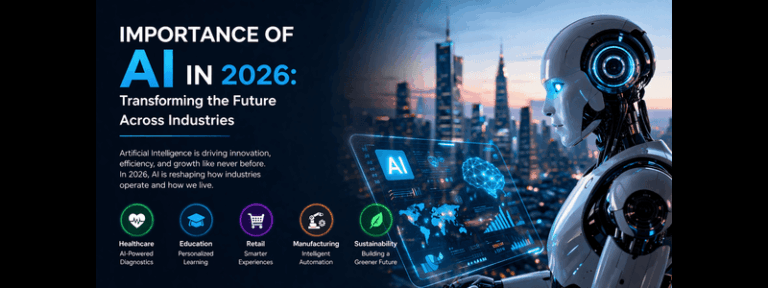
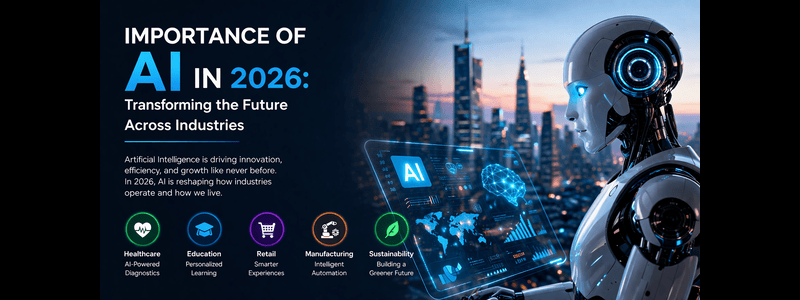
Artificial Intelligence (AI) is not a far-off vision, it is now an essential staple of the contemporary innovation. In the year 2026, AI has become a potent tool that transforms industries, economies, and the day-to-day life. Efficiency, personalization, and growth on a scale never seen before are being promoted by AI, which automates repetitive work, facilitates sophisticated decision-making, and so forth.
One of the biggest reasons of this change is the increased focus on AI Training that provides the skills necessary to make proper use of AI technologies by individuals and organizations. To keep up with the growing digitalization of the world, businesses, governments and individuals are using AI to stay competitive.
1. The Future of AI as the Future of Digital Transformation.
AI will be at the core of digital transformation strategies in organizations in 2026. Firms no longer simply adopt technology, they are moving towards being AI first enterprises. AI systems are acquainted with workflows to ease the operations, minimize expenses, and improve productivity.
Nonetheless, the effectiveness of such implementations greatly relies on adequate AI Training so that staff can know how to operate the AI system and interpret information-based insights in a productive manner.
2. Revolutionizing Healthcare
One of the most effective fields that AI influences is healthcare. Machine learning algorithms help identify diseases in patients at an early stage and with precision by examining patient data and medical histories alongside imaging outcomes.
Tools based on AI are also allowing customized treatments and enhancing patient outcomes. By means of appropriate AI Training, medical workers will be able to use these technologies more effectively, which means engaging in more efficient and accurate care delivery.
3. Improving Customer Experience.
The expectations of customers have radically changed, and AI is in the lead of providing personal experiences. AI is also applied in businesses to study the behavior and preferences of customers to provide personal recommendations and services.
Virtual assistants and chatbots offer immediate support, whereas AI-based analytics assists in enhancing customer interaction and satisfaction in all industries.
4. Revolutionizing Education and Learning.
The integration of AI has caused a significant change in education. It is now more personal, interactive and accessible. Knowledge retention increases because AI-powered platforms tailor to the learning styles of an individual.
The Virtual tutors, automated grading systems and intelligent content delivery are assisting students and teachers be better.
5. Creating Business and Industry Innovations.
AI is driving innovation in finance, retail, and manufacturing. AIs are being applied to predictive analytics, process automation, and smarter decision-making by business organizations.
In banking to retail, AI is assisting organizations optimize their operations and enhance profitability by detecting frauds to managing inventory.
6. Workforce Evolution and Automation.
The automation process is transforming the labor market by replacing routine jobs and providing workers with a chance to engage in high-level and innovative activities. On the one hand, there are still changing roles, but on the other hand, there is new work in the area of AI.
Individuals that invest in upskilling and lifelong learning stand a better chance of succeeding in this changing job market.
7. Improving Cybersecurity
As the number of cyber threats increases, AI is becoming a key supporting tool in enhancing cybersecurity. Artificial intelligence systems are able to identify anomalies and react to the threats on-the-fly.
These are intelligent systems that are continuously learning and adapting thus being more effective compared to conventional methods of security.
8. The development of Smart Cities and Sustainability.
The smart cities are being developed by AI, which is used to optimize the infrastructure and enhance resource management. AI is making cities more sustainable, in terms of traffic control to energy efficiency.
Global climate change efforts are also being assisted by environmental monitoring and predictive analytics.
9. Ethical Issues and Problems.
With the increasing use of AI, issues like privacy of data, favoritism, and transparency gain importance. Organizations are striving to create responsible AI practices and regulation systems.
The consideration of fairness and accountability in the systems of AI is the key to achieving trust and long-term success.
10. The Future of AI Beyond 2026
The future of AI is about possibilities and it is possible to have more forward leaps in generative AI, autonomous systems, and smart automation. The combination of AI and such technologies as IoT and blockchain will open new prospects.
AI is going to keep transforming businesses, inventing new business models, and defining the way we live and work.
Conclusion
The role of AI in 2026 is difficult to overestimate. It is improving industries, increasing productivity, and propagating innovation at all levels.
With AI on the rise, the skill to comprehend and utilize it in the most efficient way will be a significant distinguishing factor. The individuals and organizations that adopt learning and adaptation will be in the best position to survive in such an AI-driven future.
About the Author